
Here, we’ll go over some examples of using per-protocol, censoring. First we need to load the library before getting in to some sample use cases.
Per-protocol, censoring, weights in pre-expanded data and no truncation, no excused conditions (i.e. static interventions)
options <- SEQopts(# tells SEQuential to create Kaplan-Meier curves
                   km.curves = TRUE,
                   # tells SEQuential to weight the outcome model
                   weighted = TRUE,
                   # tells SEQuential to build weights from the pre-expanded data
                   weight.preexpansion = TRUE)

# use some example data in the package
data <- SEQdata
model <- SEQuential(data,
                    id.col = "ID",
                    time.col = "time",
                    eligible.col = "eligible",
                    treatment.col = "tx_init",
                    outcome.col = "outcome",
                    time_varying.cols = c("N", "L", "P"),
                    fixed.cols = "sex",
                    method = "censoring",
                    options = options)
#>
#> Full dataset: 12,180 observations, 11 variables
#>
#> Non-required columns provided, pruning for efficiency
#>
#> Pruned
#>
#> Original dataset (eligible subjects): 9,203 observations, 9 variables
#>
#> Expanding Data...
#>
#> Pre-filter expansion: 310,080 observations
#>
#> Expanded dataset (pre-censoring): 248,485 observations, 15 variables
#>
#> Expanded dataset (post-censoring): 102,749 observations, 15 variables
#>   entering outcome model (uncensored): 96,251
#>   artificially censored (treatment switch): 6,498
#>
#> Expansion Successful
#>
#> Final analysis dataset: 102,749 observations, 15 variables
#>
#> Moving forward with censoring analysis
#>
#> censoring model created successfully
#>
#> Creating Survival curves
#>
#> Completed

# retrieve risk plot
km_curve(model, plot.type = "risk")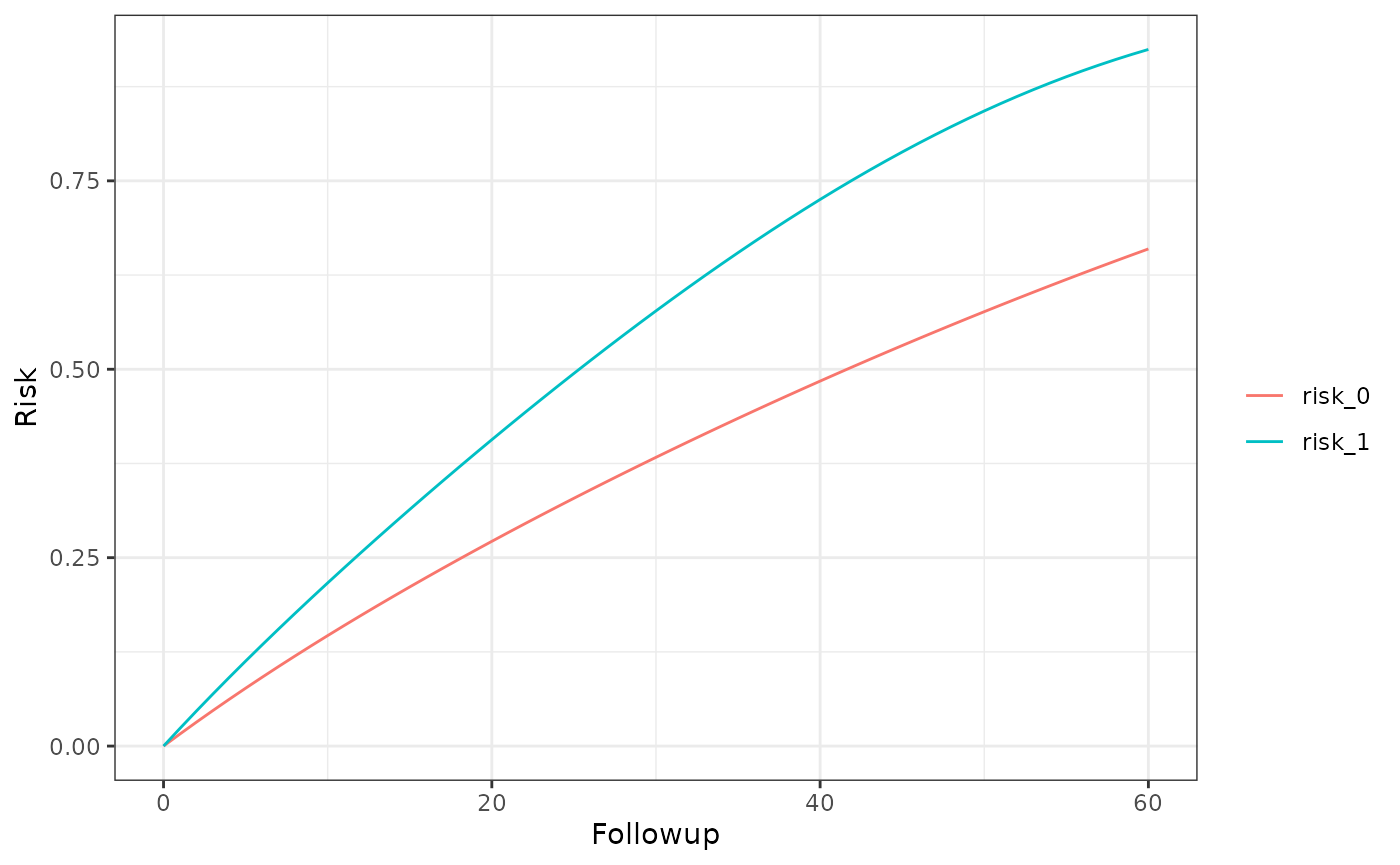
# retrieve survival and risk data
survival_data <- km_data(model)
risk_data(model)
#> Index: <Followup>
#>       Method Followup      A      Risk
#>       <char>    <num> <char>     <num>
#> 1: censoring       60      0 0.6596589
#> 2: censoring       60      1 0.9243520
risk_comparison(model)
#>    Followup    A_x    A_y Risk Ratio Risk Difference
#>       <num> <fctr> <fctr>      <num>           <num>
#> 1:       60 risk_0 risk_1  1.4012576       0.2646931
#> 2:       60 risk_1 risk_0  0.7136447      -0.2646931
Per-protocol, censoring, weights in post-expanded data and no truncation, no excused conditions (i.e. static interventions)
options <- SEQopts(km.curves = TRUE,
                   weighted = TRUE,
                   # tells SEQuential to build weights from the post-expanded data
                   weight.preexpansion = FALSE)

data <- SEQdata
model <- SEQuential(data,
                    id.col = "ID",
                    time.col = "time",
                    eligible.col = "eligible",
                    treatment.col = "tx_init",
                    outcome.col = "outcome",
                    time_varying.cols = c("N", "L", "P"),
                    fixed.cols = "sex",
                    method = "censoring",
                    options = options)
#>
#> Full dataset: 12,180 observations, 11 variables
#>
#> Non-required columns provided, pruning for efficiency
#>
#> Pruned
#>
#> Original dataset (eligible subjects): 9,203 observations, 9 variables
#>
#> Expanding Data...
#>
#> Pre-filter expansion: 310,080 observations
#>
#> Expanded dataset (pre-censoring): 248,485 observations, 18 variables
#>
#> Expanded dataset (post-censoring): 102,749 observations, 18 variables
#>   entering outcome model (uncensored): 96,251
#>   artificially censored (treatment switch): 6,498
#>
#> Expansion Successful
#>
#> Final analysis dataset: 102,749 observations, 18 variables
#>
#> Moving forward with censoring analysis
#>
#> censoring model created successfully
#>
#> Creating Survival curves
#>
#> Completed

km_curve(model, plot.type = "risk")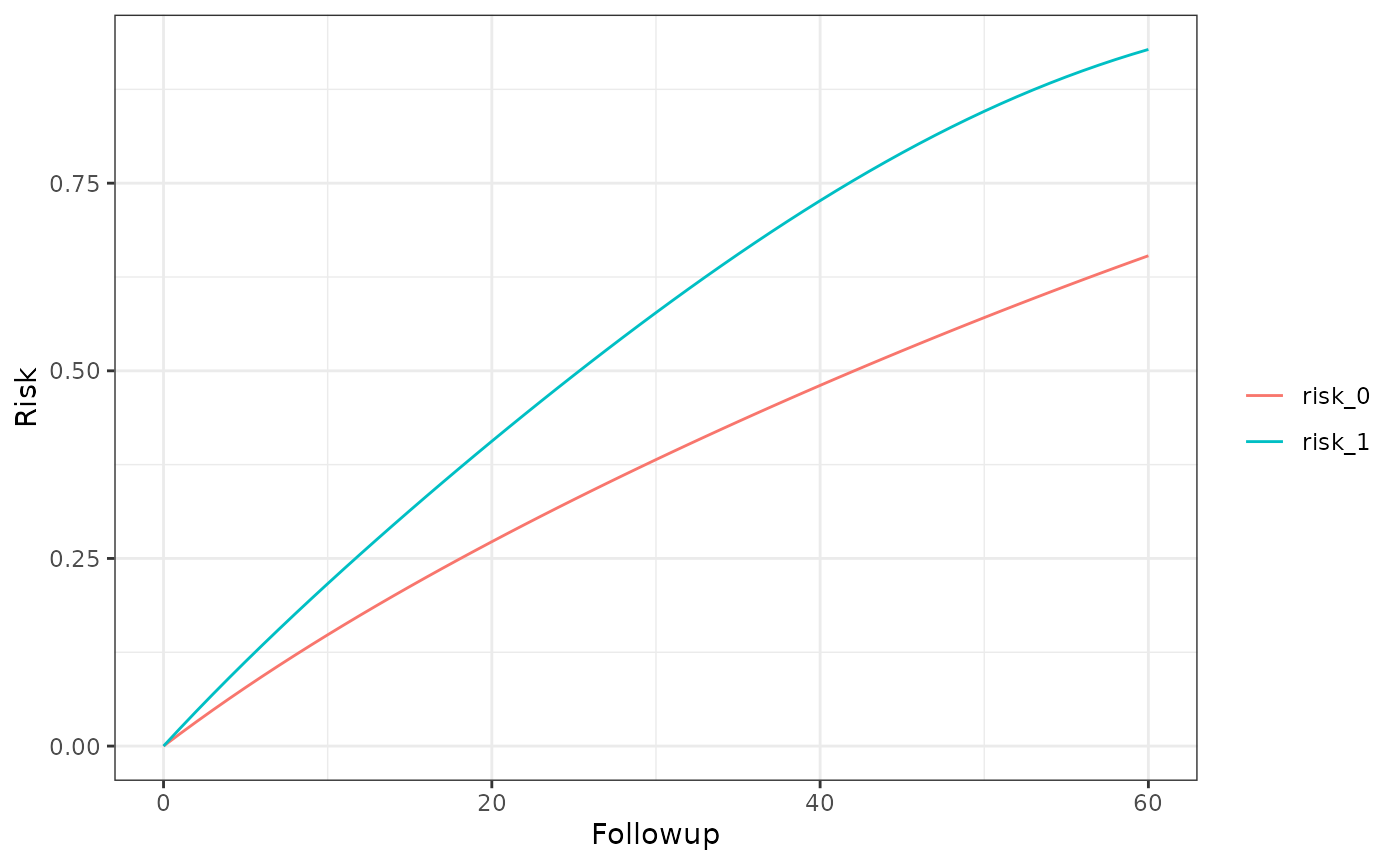
risk_data(model)
#> Index: <Followup>
#>       Method Followup      A      Risk
#>       <char>    <num> <char>     <num>
#> 1: censoring       60      0 0.6533049
#> 2: censoring       60      1 0.9281893
risk_comparison(model)
#>    Followup    A_x    A_y Risk Ratio Risk Difference
#>       <num> <fctr> <fctr>      <num>           <num>
#> 1:       60 risk_0 risk_1  1.4207598       0.2748844
#> 2:       60 risk_1 risk_0  0.7038488      -0.2748844
Per-protocol, censoring, weights in pre-expanded data and no truncation, excused conditions for initiators and non-initiators (i.e. dynamic interventions)
options <- SEQopts(km.curves = TRUE,
                   weighted = TRUE,
                   weight.preexpansion = TRUE,
                   # tells SEQuential to run a dynamic intervention
                   excused = TRUE,
                   # tells SEQuential to use columns excusedOne and
                   # excusedZero as excused conditions for treatment switches
                   excused.cols = c("excusedZero", "excusedOne"),
                   # tells SEQuential to expect treatment levels 0, 1
                   # (mapping to the same positions as the list in excused.cols)
                   treat.level = c(0, 1))
data <- SEQdata
model <- SEQuential(data,
                    id.col = "ID",
                    time.col = "time",
                    eligible.col = "eligible",
                    treatment.col = "tx_init",
                    outcome.col = "outcome",
                    time_varying.cols = c("N", "L", "P"),
                    fixed.cols = "sex",
                    method = "censoring",
                    options = options)
#>
#> Full dataset: 12,180 observations, 11 variables
#>
#> Original dataset (eligible subjects): 9,203 observations, 11 variables
#>
#> Expanding Data...
#>
#> Pre-filter expansion: 310,080 observations
#>
#> Expanded dataset (pre-censoring): 248,485 observations, 18 variables
#>
#> Expanded dataset (post-censoring): 185,423 observations, 18 variables
#>   entering outcome model (uncensored): 183,315
#>   artificially censored (treatment switch): 2,108
#>
#> Expansion Successful
#>
#> Final analysis dataset: 185,423 observations, 18 variables
#>
#> Moving forward with censoring analysis
#>
#> censoring model created successfully
#>
#> Creating Survival curves
#>
#> Completed

km_curve(model, plot.type = "risk")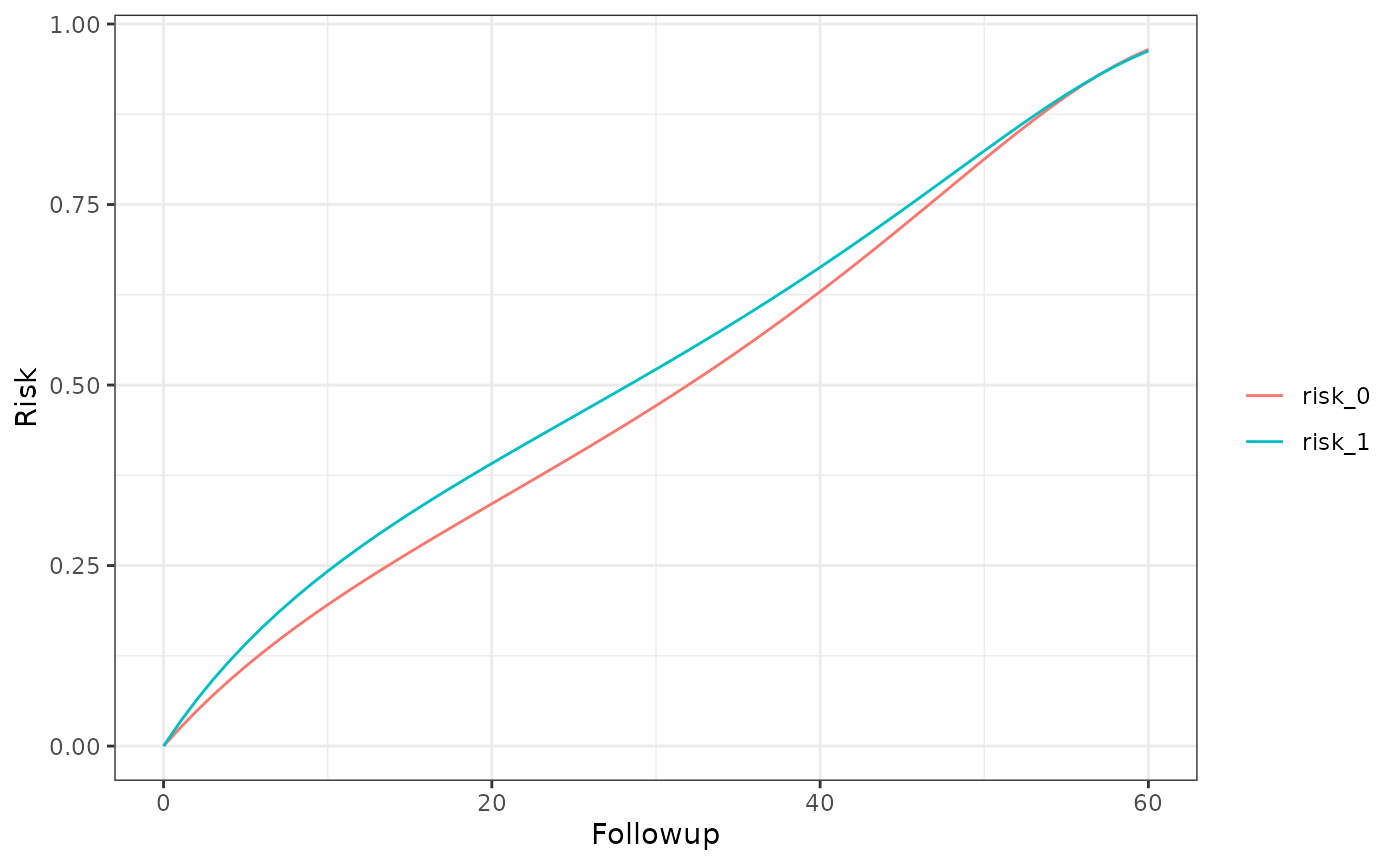
risk_data(model)
#> Index: <Followup>
#>       Method Followup      A      Risk
#>       <char>    <num> <char>     <num>
#> 1: censoring       60      0 0.9647942
#> 2: censoring       60      1 0.9627635
risk_comparison(model)
#>    Followup    A_x    A_y Risk Ratio Risk Difference
#>       <num> <fctr> <fctr>      <num>           <num>
#> 1:       60 risk_0 risk_1  0.9978953    -0.002030621
#> 2:       60 risk_1 risk_0  1.0021092     0.002030621
Per-protocol, censoring, weights in post-expanded data and no truncation, excused conditions for initiators and non-initiators (i.e. dynamic interventions)
options <- SEQopts(km.curves = TRUE,
                   weighted = TRUE,
                   weight.preexpansion = FALSE,
                   excused = TRUE,
                   excused.cols = c("excusedZero", "excusedOne"),
                   treat.level = c(0, 1),
                   weight.p99 = TRUE)
data <- SEQdata
model <- SEQuential(data,
                    id.col = "ID",
                    time.col = "time",
                    eligible.col = "eligible",
                    treatment.col = "tx_init",
                    outcome.col = "outcome",
                    time_varying.cols = c("N", "L", "P"),
                    fixed.cols = "sex",
                    method = "censoring",
                    options = options)
#>
#> Full dataset: 12,180 observations, 11 variables
#>
#> Original dataset (eligible subjects): 9,203 observations, 11 variables
#>
#> Expanding Data...
#>
#> Pre-filter expansion: 310,080 observations
#>
#> Expanded dataset (pre-censoring): 248,485 observations, 21 variables
#>
#> Expanded dataset (post-censoring): 185,423 observations, 21 variables
#>   entering outcome model (uncensored): 183,315
#>   artificially censored (treatment switch): 2,108
#>
#> Expansion Successful
#>
#> Final analysis dataset: 185,423 observations, 21 variables
#>
#> Moving forward with censoring analysis
#>
#> censoring model created successfully
#>
#> Creating Survival curves
#>
#> Completed

km_curve(model, plot.type = "risk")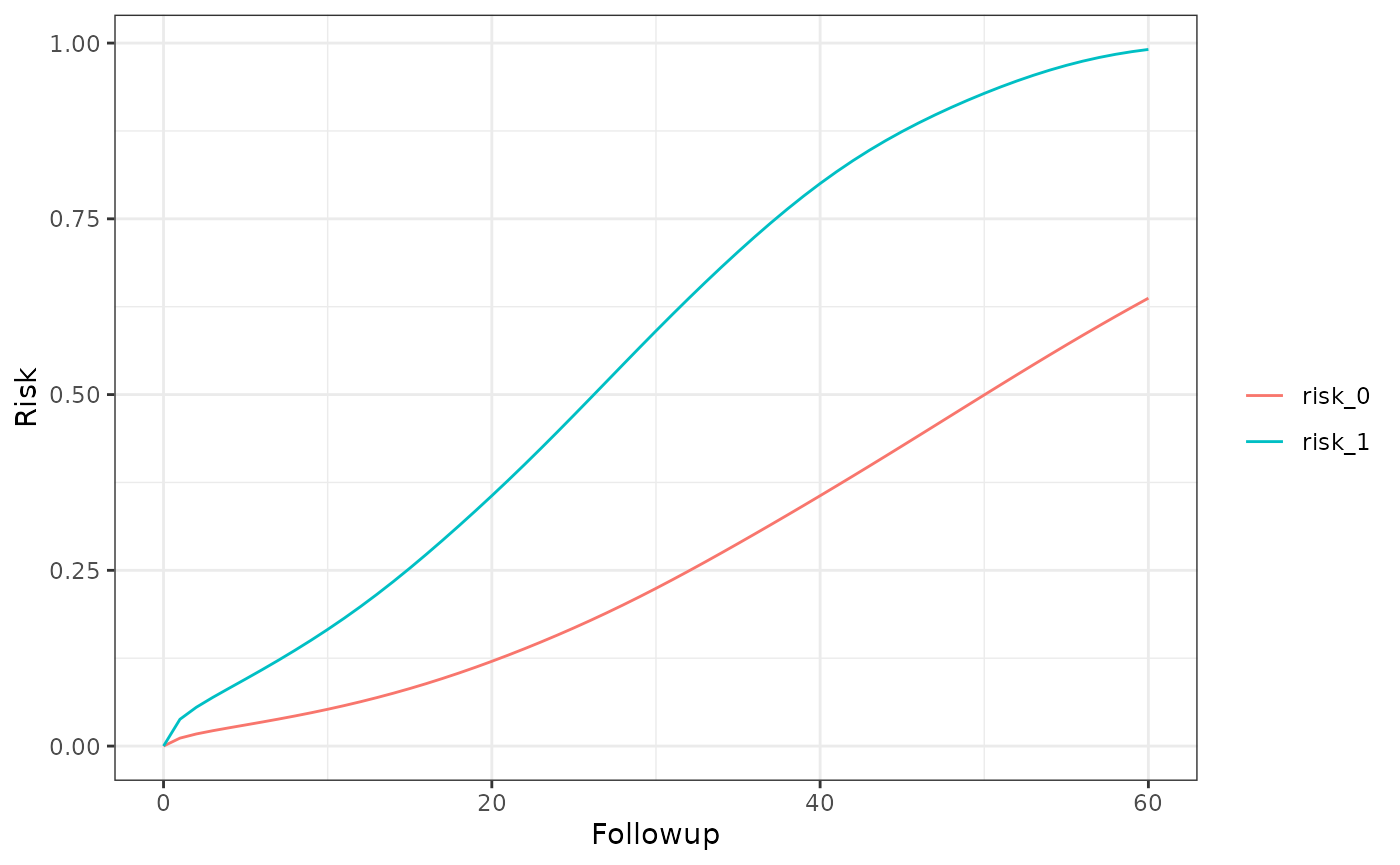
risk_data(model)
#> Index: <Followup>
#>       Method Followup      A      Risk
#>       <char>    <num> <char>     <num>
#> 1: censoring       60      0 0.6371076
#> 2: censoring       60      1 0.9909442
risk_comparison(model)
#>    Followup    A_x    A_y Risk Ratio Risk Difference
#>       <num> <fctr> <fctr>      <num>           <num>
#> 1:       60 risk_0 risk_1  1.5553797       0.3538366
#> 2:       60 risk_1 risk_0  0.6429298      -0.3538366
Per-protocol, censoring, weights in post-expanded data and no truncation, excused conditions for initiators and non-initiators (i.e. dynamic interventions) and a competing event
options <- SEQopts(km.curves = TRUE,
                   weighted = TRUE,
                   weight.preexpansion = FALSE,
                   excused = TRUE,
                   excused.cols = c("excusedZero", "excusedOne"),
                   treat.level = c(0, 1),
                   # add a competing event
                   compevent = "LTFU")

data <- SEQdata.LTFU
model <- SEQuential(data,
                    id.col = "ID",
                    time.col = "time",
                    eligible.col = "eligible",
                    treatment.col = "tx_init",
                    outcome.col = "outcome",
                    time_varying.cols = c("N", "L", "P"),
                    fixed.cols = "sex",
                    method = "censoring",
                    options = options)
#>
#> Full dataset: 54,687 observations, 13 variables
#>
#> Non-required columns provided, pruning for efficiency
#>
#> Pruned
#>
#> Original dataset (eligible subjects): 29,624 observations, 12 variables
#>
#> Expanding Data...
#>
#> Pre-filter expansion: 1,609,859 observations
#>
#> Expanded dataset (pre-censoring): 1,119,229 observations, 22 variables
#>
#> Expanded dataset (post-censoring): 810,880 observations, 22 variables
#>   entering outcome model (uncensored): 803,021
#>   artificially censored (treatment switch): 7,859
#>
#> Expansion Successful
#>
#> Final analysis dataset: 810,880 observations, 22 variables
#>
#> Moving forward with censoring analysis
#>
#> censoring model created successfully
#>
#> Creating Survival curves
#>
#> Completed

km_curve(model, plot.type = "risk")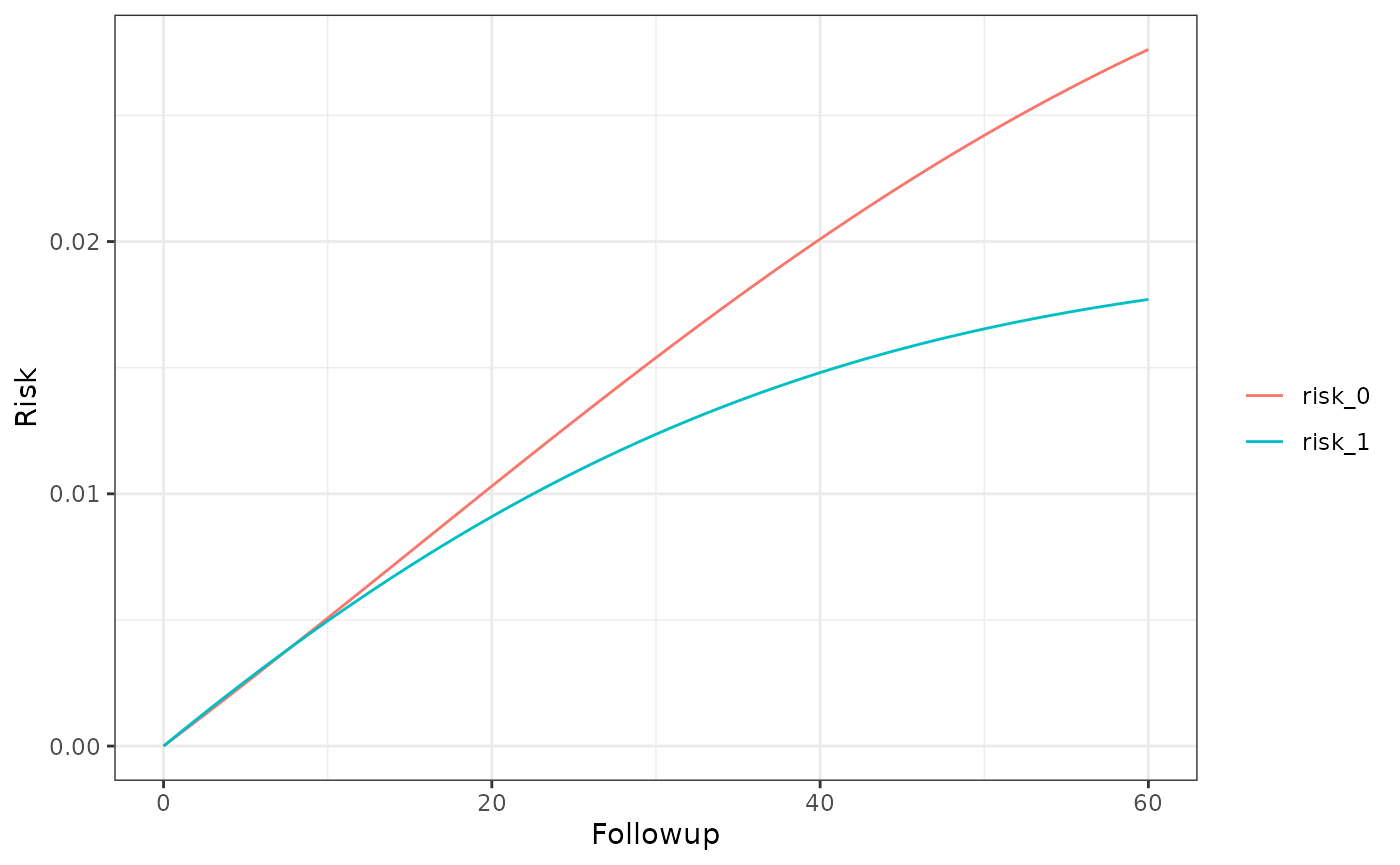
risk_data(model)
#> Index: <Followup>
#>       Method Followup      A       Risk
#>       <char>    <num> <char>      <num>
#> 1: censoring       60      0 0.02542994
#> 2: censoring       60      1 0.01646542
risk_comparison(model)
#>    Followup    A_x    A_y Risk Ratio Risk Difference
#>       <num> <fctr> <fctr>      <num>           <num>
#> 1:       60  inc_0  inc_1  0.6474815    -0.008964524
#> 2:       60  inc_1  inc_0  1.5444456     0.008964524
Per-protocol, censoring, weights in post-expanded data and no truncation, excused conditions for initiators and non-initiators (i.e. dynamic interventions) and hazard ratio
options <- SEQopts(# tell SEQuential to run hazard ratios
                   hazard = TRUE,
                   weighted = TRUE,
                   weight.preexpansion = FALSE,
                   excused = TRUE,
                   excused.cols = c("excusedZero", "excusedOne"),
                   weight.p99 = TRUE)

data <- SEQdata
model <- SEQuential(data,
                    id.col = "ID",
                    time.col = "time",
                    eligible.col = "eligible",
                    treatment.col = "tx_init",
                    outcome.col = "outcome",
                    time_varying.cols = c("N", "L", "P"),
                    fixed.cols = "sex",
                    method = "censoring",
                    options = options)
#>
#> Full dataset: 12,180 observations, 11 variables
#>
#> Original dataset (eligible subjects): 9,203 observations, 11 variables
#>
#> Expanding Data...
#>
#> Pre-filter expansion: 310,080 observations
#>
#> Expanded dataset (pre-censoring): 248,485 observations, 21 variables
#>
#> Expanded dataset (post-censoring): 185,423 observations, 21 variables
#>   entering outcome model (uncensored): 183,315
#>   artificially censored (treatment switch): 2,108
#>
#> Expansion Successful
#>
#> Final analysis dataset: 185,423 observations, 21 variables
#>
#> Moving forward with censoring analysis
#>
#> Completed
hazard_ratio(model)
#> Hazard ratio          LCI          UCI
#>     3.004905           NA           NA